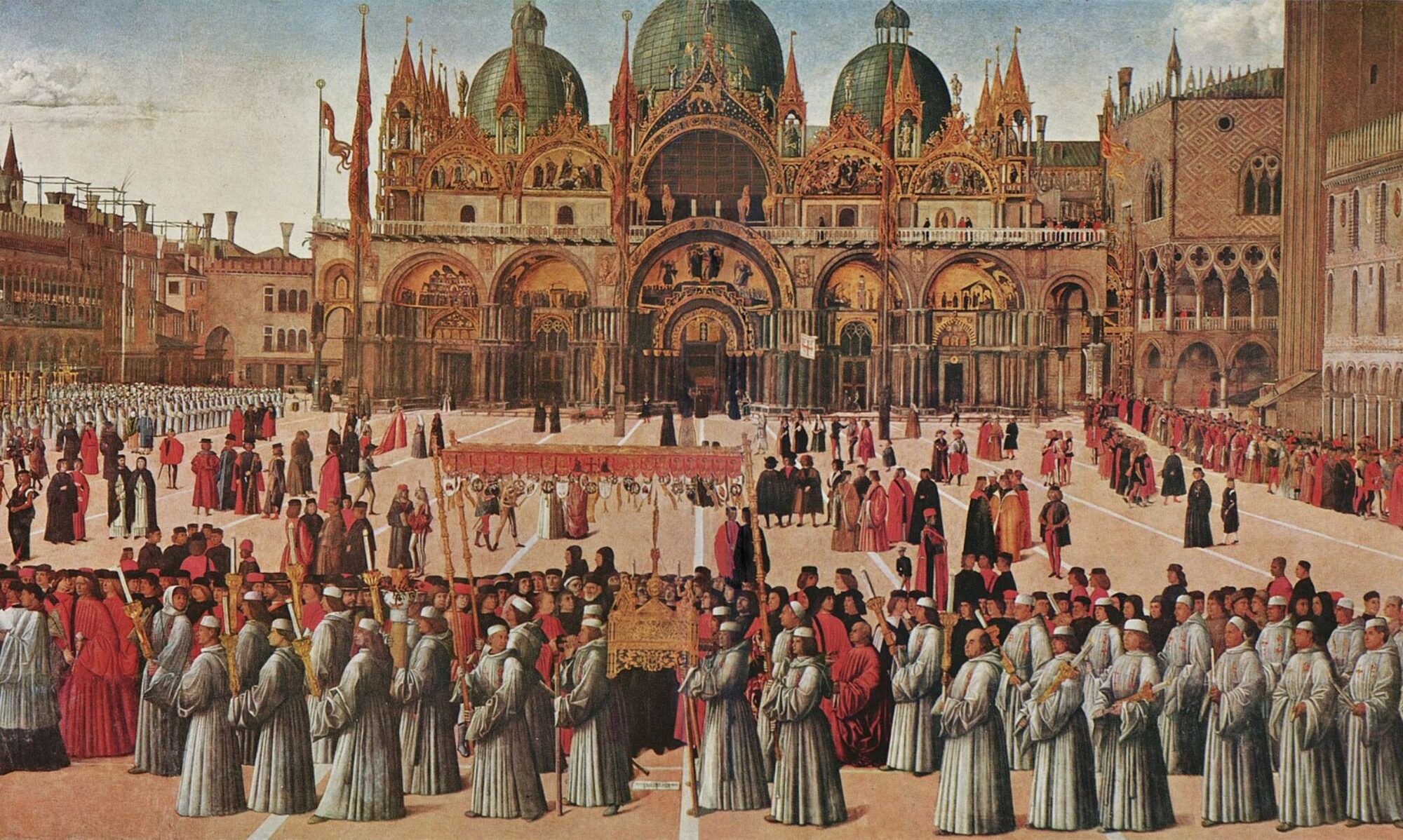
Master Adamo lies a bloated mass of “watery rot.” His amorphous frame bears his diseased paunch and distended limbs, as his lips curl and crack under his parching fever—despite being a waterlogged waste. He lies before Dante the Pilgrim and Virgil and explains how King Minos poured him into the last ditch of the eighth circle of hell. He was a counterfeiter of Florentine florins. He blurred the lines of reality in life and now he lays blurred—a poor counterfeit of his former self.
Continue reading “Our Contraceptive Speech”A Brief Introduction to the Common Good
The common good is an uncommon concept today, and the genuine article is often confused with counterfeits. It may, therefore, be helpful to set out clearly and simply some definitions and distinctions, to explain what ‘the common good’ means to the integralist, as opposed to what it means to the totalitarian, the utilitarian, or the liberal. These notes are mostly gathered from other Josias posts; follow the links and footnotes for more in-depth treatments.
Continue reading “A Brief Introduction to the Common Good”Ecology and the Theology of Creation
On April 22, the St. Basil Institute for the Theology of Creation will be hosting an online conference on ecology and the theology of creation. Pope Francis has spoken about the importance of the current ecological crisis throughout his pontificate. While the Holy Father discussed the need for a uniquely Catholic approach to this crisis in Laudato Si, unfortunately most Catholics who engage with these issues continue to do so from a secular perspective. Why is a uniquely Catholic approach so important?
Continue reading “Ecology and the Theology of Creation”Friendship and Politics
The Nature of Friendship
Aristotle discusses friendship near the end of his Nicomachean Ethics, immediately after a discussion of pleasure, and before the final discussion of true happiness. This order is appropriate, because friendship is both man’s greatest pleasure and necessary for the happiness of man’s earthly life. True happiness is to know the good and to have it, and friendship is among the greatest goods a person can have.
Continue reading “Friendship and Politics”“Legal Marriage” and Legal Positivism
By now, most of the Catholic internet world has heard about the minor blow up concerning Rev. James Martin, SJ and his tweet, which claimed that “Pete Buttigieg is married,” itself a response to a Catholic League article stating that “It is true that Buttigieg is legally married, but that is a legal fiction.”
Continue reading ““Legal Marriage” and Legal Positivism”Uncommon Confusion: The New Natural Law Theory’s Confusion of Predication and Causality Destroys the Natural Order
The following lecture was delivered to the faculty of Thomas Aquinas College in the fall of 2020.
When Aquinas presents his understanding of the natural law, he unifies it under a single precept, “Good is to be done and pursued, and evil is to be shunned.”[1] This precept forms the basis for every other natural law precept—which is why it is a unifying principle for the natural law as a whole[2]—because it expresses the first principle of any action whatsoever. We do not commit a fully human act except insofar as an act seems to be good or to be aimed at a good (or away from its opposite). The precept is universal; it grounds any and every pursuit of goods. But there is a question: What, precisely, is meant by “good” in this precept?
Continue reading “Uncommon Confusion: The New Natural Law Theory’s Confusion of Predication and Causality Destroys the Natural Order”The Child as a Common Good
by Michael Berndt
For my wife.
The title of this essay is “The Child as a Common Good,” which would seem to be an unfortunate topic to defend, for at least two reasons. The first is that the notion of a common good requires a degree of universality that the child, as a particular subject, apparently fails to attain. The second reason follows from the principle that because a common good is more universal than a singular good, it is also more communicable. As Charles De Koninck has put it, the common good “reaches the singular more than the singular good: it is the greater good of the singular” (16). Now if the child as a good is held in common by anyone, then it is certainly by the child’s parents; but in practice it is perhaps rare to hear parents echoing De Koninck’s words with respect to their children. The reality, in fact, seems closer to the opposite: many parents would describe the relationship between their own singular goods and their children in sacrificial terms—and every sacrifice, however willing, must imply some opposition between goods. The child as a good, therefore, seems not to “reach the singular more than the singular good,” and so the child appears not to fit the definition of a common good for his or her parents.
Continue reading “The Child as a Common Good”Integralism and the Hermeneutic of Reform
The term integralism does not describe a movement or a philosophical school. It is simply a word coined in the nineteenth century to describe the opposite of a grievous error condemned by the Church— liberalism. It is thus analogous to terms such as dyophysite, iconodule or transubstantiationist. It names orthodoxy in a particular area of Catholic teaching.
Continue reading “Integralism and the Hermeneutic of Reform”God’s Knowledge of Future Contingents: A Response to Alasdair MacIntyre
Alasdair MacIntyre—one of greatest Catholic thinkers of his generation, and one of the most formative influences on my own intellectual development—has unfortunately capped his career by denying divine omniscience. At this weekend’s fall conference for the de Nicola Center for Ethics and Culture at the University of Notre Dame, MacIntyre delivered a keynote lecture entitled “The Apparent Oddness of the Universe: How to Account for It?” In this lecture, he argues that the Catholic tradition has been excessive in its praise for our All-Knowing God. For when it comes to future contingents—or at least the kind of creative and unpredictable future contingents that MacIntyre calls “singularities”—MacIntyre claims that God cannot know them any more than you or I can. “Until [a free created] agent finally makes her or his decision,” MacIntyre explains,
her or his future action is undetermined. There is no fact of the matter about what she or he is going to decide or to do, nothing to make any statement about, true or false. Not only does she or he not know what she or he is going to do, no one else can be said to know this either, including God. . . . So, even if an omniscient God does exist, there have been and will be numerous occasions on which he cannot be said to know what will be done or happen, until it is done or happens.
I think MacIntyre is horribly mistaken. In this essay, I will proceed in three parts: First, I will explain the orthodox tradition concerning God’s knowledge of future contingents, proceeding through Aristotle and St. Boethius and St. Thomas Aquinas. Second, I will say something about where Duns Scotus and William of Ockham fit into all of this, two thinkers whose accounts I do not accept, but who nevertheless agree with the conclusion of the orthodox tradition that God knows all things—including future contingents. Third, I will critique another modern Catholic philosopher who denied God’s omniscience in this regard, namely Peter Geach, whom MacIntyre cited in his replies to the objections in the Q&A, to justify his own imposition of limits on God’s knowledge.
Continue reading “God’s Knowledge of Future Contingents: A Response to Alasdair MacIntyre”Félix Sardá y Salvany on the Word “Integralists”
Editor’s Introduction
The Catalan priest Félix Sardá y Salvany (1841-1916) is most famous for his book Liberalism is a Sin. One of the first mentions of the word “integralism” [or “integrism”] by the Holy See was in response to El proceso del integrismo, an attack on Don Sardá’s book by Canon Celestino de Pazos.[1] Both books had been sent to the Sacred Congregation for the Index, which responded in 1887 that Pazos’s book should be withdrawn from circulation, and praised Fr. Sardá’s book as its “exposition and defense of the sound doctrine therein set forth with solidity, order, and lucidity.”[2] Liberalism is a Sin, become the vade-mecum of the first political movement to be given the name “integralist,” namely the movement founded by the Carlist writer Ramón Nocedal Romea (1842-1907), when he broke with the mainstream of Carlism, because the Carlist claimant to the throne was making what he considered untenable compromises with liberalism.[3] What exactly was meant by calling this movement integralist? In the Manifesto of Burgos, written by Nocedal and signed by a number of Spanish traditionalist newspapers in 1888, which is seen as the beginning of the Integralist party in Spain, reference is made again and again to the “integrity” of the adherence of the signatories to Catholic doctrine and tradition, to “la integridad y pureza de las doctrinas,”and “la integridad de nuestra doctrina y nuestra intransigencia con los errores modernos,”and so on.[4] This is why they were known as integralists: because of their integral adherence to Catholic doctrine, and their intransigent rejection of modern errors. One of the Catholic teachings to which they were particularly insistent in their adherence (since it was under particular attack at the time) was the teaching on the relation of spiritual and temporal power. The Manifesto of Burgos uses the traditional analogy of body and soul to explain the teaching:
As the body to the soul, so must the state be united and subordinated to the Church, the lesser luminary to the greater, the temporal sword to the spiritual sword, according to the terms and conditions that the Church of God lays down, and are established in our traditional laws.[5]
In 1889 El Siglo Futuro, the newspaper edited by Nocedal, printed a talk by Don Sardá entitled “¿Integristas?”.[6]Sardá explains that the name integralists is one that was being given to their movement by its enemies, but he argues that they ought to embrace the name. We are pleased to offer a translation of Don Sardá’s talk below.
Integralists?
A Conference read at the Catholic Academy (before Catholic Youth), of Sabadell by Don Felix Sardá y Salvany, Priest, Counselor of the same and Director of the Revista Popular.
Translated by HHG
The Parrot answered pertly,
As with argument conclusive,—
"You are nothing but a Purist,
Of taste foolishly exclusive."—?
"Thanks for the compliment," quoth Magpie, curtly.
(Iriarte, The Two Parrots and the Magpie)
Integralists? Yes, my dear gentlemen, and I accept the name as an honor. It is about this that I have wished to speak to you here at our beloved Academy—after not being able to speak here for a long time—and have thought it fitting to choose as theme for my familiar Conference the present epithet or sobriquet with which it seems our enemies seek to defame us. Under this name I wish to see you present yourself with saintly loftiness and Christian pride. I assure you that, by the grace of God, this is how I am; I am proud of my faith, of my baptism, of my Catholic education and of my Catholic priesthood and of everything it constitutes. Thanks be to Heaven, regarding my mode of being in the supernatural and Christian order.
Continue reading “Félix Sardá y Salvany on the Word “Integralists””